

Article: Japanese Minimalist Fashion for Women: A 2026 Guide


Japanese Minimalist Fashion for Women: A 2026 Guide
Table of Contents
- What Japanese Minimalist Fashion for Women Actually Means
- Japanese Minimalism vs Western Minimalism: The Key Differences
- Key Elements: Colour, Fabric, and Silhouette
- How to Build a Capsule Wardrobe with Japanese Minimalist Pieces
- Styling Japanese Minimalist Outfits for Work and Weekends
- Finding Sustainable Minimalist Clothing Brands That Last
- Caring for Your Minimalist Wardrobe
- Frequently Asked Questions
Last Updated: September 18, 2026
What Japanese Minimalist Fashion for Women Actually Means
Japanese minimalist fashion for women is a design philosophy built on reduction, where every garment earns its place through cut, fabric and function rather than decoration. At All Style, we see this in pieces that look quiet on the hanger and remarkable on the body. This guide covers the aesthetic, how to build a capsule wardrobe around it, and where to find sustainable minimalist clothing brands worth the investment.
The Core Principles Behind the Aesthetic
Three ideas sit underneath the aesthetic. First, ma (negative space): the gap between garments is as considered as the garments themselves. Second, shibui: beauty that reveals itself slowly. Third, functionality: a piece that cannot be worn three ways does not belong in the wardrobe.
Japanese Minimalism vs Western Minimalism: The Key Differences
Western minimalism tends to be architectural and sharp: black, white, grey, structured shoulders. Japanese minimalism keeps the clean silhouettes but softens everything around them.
| Element | Western Minimalism | Japanese Minimalism |
|---|---|---|
| Palette | Black, white, cool grey | Warm neutrals, earth tones, indigo |
| Silhouette | Structured, tailored | Relaxed, oversized, draped |
| Fabric | Crisp cotton, wool suiting | Linen, cotton, wool, texture-led |
| Philosophy | Reduce and refine | Reduce, layer, and live in it |
Key Elements: Colour, Fabric, and Silhouette
Get these three right and the rest falls into place: colour sets the mood, fabric carries the quality, and silhouette decides whether a piece flatters or fights you.
Neutral Colour Palettes and Earth Tones
Start with a neutral color palette that leans warm: ecru, oatmeal, stone, sand, charcoal, deep indigo and soft black. Earth tones do the heavy lifting, so a monochromatic outfit never looks flat. Build around two or three base neutrals plus one accent.
Natural Fabrics and Textural Contrast
Natural fibers separate a piece that lasts from one that pills by month three. Linen, cotton and wool form the backbone, with silk and cashmere as accents. To avoid a bland result, use textural contrast: a smooth cotton top against a slubby linen trouser, or a fine knit over crisp poplin.
How to Build a Capsule Wardrobe with Japanese Minimalist Pieces
A capsule wardrobe is a small, curated collection of interchangeable pieces covering most occasions. For this aesthetic, aim for roughly 25 to 35 items including shoes and outerwear. The ratio matters more than the number: around 60 per cent tops and bottoms, 40 per cent outerwear, footwear and accessories.
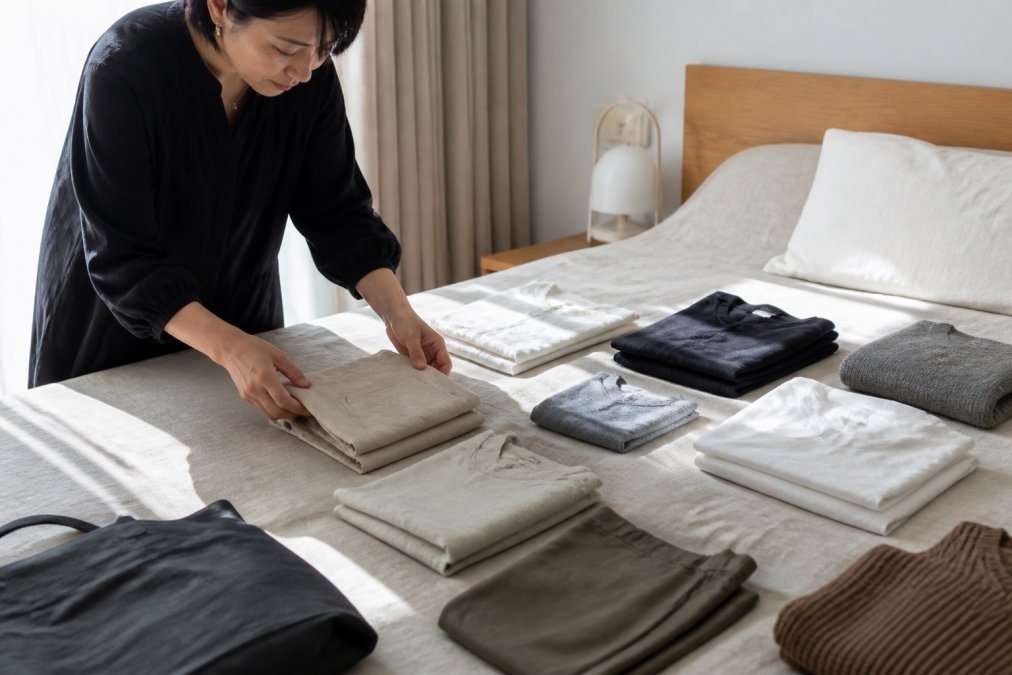
Here is the sequence that works:
- Choose your base palette. Two neutrals plus one earth tone.
- Lock in your bottoms. Wide-leg trousers, a straight midi skirt, relaxed denim, tailored shorts.
- Add your tops. Two linen shirts, two cotton tees, one fine knit, one silk camisole.
- Layer with intent. A relaxed blazer, an oversized shirt-jacket, a long cardigan, one coat.
- Finish with footwear and accessories. Leather flats, a low heel, one structured bag, one soft tote.
- Audit and remove. Anything that does not mix with at least three other pieces leaves.
Adapting the Capsule to Different Body Types
Most minimalist guides assume a narrow, straight silhouette. That is a design choice, not a rule, the aesthetic adapts once you understand where volume should sit.
- Pear shapes: keep the volume on top. An oversized shirt-jacket or a boxy knit balances wider hips, while a straight midi skirt in a fluid fabric skims rather than clings. Avoid wide-leg trousers that add bulk at the hip; a tapered or straight leg reads cleaner.
- Apple shapes: use vertical lines. A long open cardigan or a column-style dress in a single neutral creates an unbroken line. Tuck tops loosely rather than fully, and choose fabrics with some weight so they drape instead of pulling.
- Hourglass shapes: the risk is losing your waist entirely under oversized pieces. Belt a long cardigan, or choose a wrap-style top in a soft knit. High-waisted wide-leg trousers with a tucked fine knit keep proportion without sharp tailoring.
- Petite frames: scale the volume. A cropped oversized shirt or a shorter shirt-jacket keeps the proportion intentional rather than swamping. Monochrome head-to-toe adds visual height.
- Tall frames: you can carry the fullest silhouettes. Longline coats, wide-leg trousers and maxi skirts in heavy linen all work without overwhelming.
Sourcing the Capsule on a Budget
You do not need niche labels. A practical split is roughly half new, half second-hand or accessible high-street, with money concentrated in the hardest-wearing pieces.
- Spend on: outerwear, footwear and knitwear. These take the most stress and show poor quality fastest.
- Save on: tees, camisoles and simple cotton shirts. A well-cut cotton tee from an accessible label performs almost identically to a designer version at a fraction of the cost.
- Thrift for: linen shirts, wool coats and leather bags. Older pieces often use denser fabric and better construction than current fast-fashion equivalents. Check the fabric label first, then the seams.
- High-street basics to look for: unbleached cotton, garment-dyed linen, and merino knits. Avoid anything labelled only as "mixed fibres", you cannot judge longevity from that.
Seasonal Adaptation Within the Same Capsule
The base capsule stays constant; only the outer layers change, keeping a small wardrobe working across all four seasons.
- Summer: single layers of linen and cotton. A loose linen shirt worn open over a cotton slip dress covers both heat and sun.
- Autumn: add a fine merino knit and a shirt-jacket. The same trousers and skirts carry over.
- Winter: layer a merino knit under a wool coat, then add a scarf. Thermal base layers in a neutral tone disappear under everything else.
- Spring: strip back to the autumn formula minus the coat, and reintroduce lighter footwear.
Styling Japanese Minimalist Outfits for Work and Weekends
Styling Japanese minimalist outfits comes down to layering, proportion and restraint. The same core pieces carry you from a Monday meeting to a Saturday market with small adjustments.
Layering for Different Seasons
Seasonal adaptation is where minimalist wardrobes usually fall apart, and where layering saves you. In summer, lean on linen and cotton in single layers; in cooler months, add a fine merino knit, then a wool coat, then a scarf. The base stays the same.
Finding Sustainable Minimalist Clothing Brands That Last
Sustainable minimalist clothing brands are defined less by marketing language than by what they can prove: where the fabric comes from, how the garment is constructed, and whether it survives more than a season.
What to Look For in Quality and Craftsmanship
Check these before you buy:
- Fabric composition stated in full, not as "mixed fibres"
- Stitching density at seams and hems, which signals construction quality
- Natural fibres over synthetic blends for breathability and longevity
- Reinforced stress points at shoulders, waistbands and pockets
- Colour consistency across the range, which suggests considered production
At All Style, our curated collection is built around European and Japanese labels chosen for exactly these qualities, and we stock pieces for women of all sizes rather than a token few.
Reading the Claims: What Australian Labelling Actually Requires
In Australia, clothing sold at retail must carry a care label under the mandatory care labelling standard administered by the Australian Competition and Consumer Commission. A brand that labels care precisely usually knows its supply chain.
- Fibre content must be disclosed, but "sustainable cotton" is not a regulated term. Look for named standards instead.
- Certifications worth recognising include GOTS (Global Organic Textile Standard) for organic fibre, OEKO-TEX Standard 100 for chemical safety, and B Corp certification for broader business accountability. These are third-party verified, not self-declared.
- Origin claims such as "made in Japan" or "made in Australia" have specific legal meaning under Australian consumer law. A brand claiming local manufacture should be able to name the factory.
Care and Maintenance: The Part Most Guides Skip
Minimalism only works if the pieces last, and longevity is mostly about care. This routine keeps a small wardrobe looking new.
Washing
- Linen and cotton: cold water, gentle cycle, low spin. Hot water and high spin break down fibres faster than wear does.
- Wool and cashmere: wash rarely, airing between wears is often enough. When you do wash, use a wool cycle or hand wash in cool water with a pH-neutral detergent.
- Silk: hand wash in cool water or dry clean. Never wring.
Drying
- Air-dry flat or on a padded hanger. Direct sun fades natural dyes, so dry in shade.
- Never tumble-dry wool or linen. Heat shrinks wool and crushes linen's structure.
Storage
- Fold knitwear flat. Hanging stretches shoulders and hem.
- Hang woven shirts, trousers and coats on shaped hangers to hold the shoulder line.
- Store out of direct sunlight and away from damp. Moths damage wool, so use cedar or lavender between seasons.
Repair
- Fix small issues early. A dropped hem or loose button repaired in week one saves the piece in year three.
- Learn one invisible mending stitch. It handles most knit snags and small holes.
- Keep spare buttons and a small repair kit. Replacing a button is a five-minute job that extends a garment's life by years.
Caring for Your Minimalist Wardrobe
Care is what keeps a minimalist wardrobe minimalist. Wash linen and cotton cold on a gentle cycle, air-dry where possible, and steam rather than iron. Wash wool rarely, by hand or on a wool cycle, and store it folded rather than hung.
Frequently Asked Questions
What is the Japanese minimalist style called?
It is often referred to as 'Japandi' when blended with Scandinavian design, but the fashion itself draws from the Japanese concept of 'shibui' (understated beauty) and 'ma' (negative space). The style focuses on clean silhouettes, natural fabrics like linen and cotton, and a neutral colour palette. It prioritises quality craftsmanship and versatility over trend-driven pieces, making it a practical approach to intentional dressing.
How can I incorporate Japanese minimalist aesthetics into my daily wardrobe?
Start by choosing a base palette of earth tones and neutrals, then add a few oversized fit pieces such as a relaxed linen shirt or wide-leg trousers. Focus on layering with natural fibers like cotton and wool. Mix and match a small curated collection of wardrobe staples. The goal is functional fashion that feels effortless, so avoid busy prints and stick to clean silhouettes that allow fluid movement.
What is the 3-3-3 rule for clothes?
The 3-3-3 rule is a packing and wardrobe strategy: three tops, three bottoms, and three pairs of shoes can create up to 27 different outfits when you mix and match. It aligns with the minimalist aesthetic by encouraging a curated collection of versatile, timeless design pieces. This approach reduces decision fatigue and supports sustainable consumption by focusing on fewer, higher-quality items.
How does Japanese minimalism differ from Western minimalism?
Japanese minimalism often places greater emphasis on textural contrast, fluid movement, and the beauty of natural imperfections, while Western minimalism can lean toward stark, structured design. Japanese minimalist fashion for women frequently incorporates oversized fit and layering to create understated elegance. Both value quality craftsmanship and neutral color palettes, but the Japanese approach tends to feel softer and more organic.
Building a wardrobe that stays relevant takes patience, and the wrong pieces cost more than the right ones. All Style curates designer clothing sourced from Europe and Japan, with sustainable, timeless minimalist essentials for women of all sizes, available in our Hobart boutique or online across the country. Browse the collection, add to cart, and build a wardrobe that flatters you for years rather than seasons.